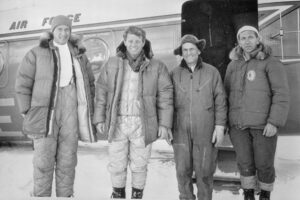
The world of adventure, exploration, and quiet courage has lost one of its most enduring figures. Jim Whittaker, the first American to stand atop Mount Everest, has passed away at the age of 97. He died peacefully at his home in Port Townsend, surrounded not by the noise of fame or the rush of headlines, but by the calm and grounded life he had chosen after years of extraordinary achievement. For many, his name will forever be tied to that historic climb in 1963—a moment that marked not only a personal triumph but a national milestone. Yet those who knew him, or who have followed his life beyond that singular accomplishment, understand that his legacy stretches far beyond one summit. It lives in the lives he touched, the wilderness he fought to protect, and the quiet philosophy that guided him through nearly a century of life.
Born and raised in Seattle, Whittaker’s connection to the natural world began early. Alongside his twin brother Lou, he discovered a passion for climbing that would shape both of their lives. The mountains were not simply challenges to conquer but places of learning, humility, and connection. Those early experiences instilled in him a deep respect for nature and an understanding that the greatest rewards often come not from reaching the top, but from the journey itself. As a young climber, he honed his skills in the rugged landscapes of the Pacific Northwest, building the resilience and determination that would eventually carry him to the highest point on Earth. His upbringing, rooted in both adventure and simplicity, laid the foundation for a life that would balance extraordinary achievement with remarkable humility.
In 1963, just ten years after Edmund Hillary and Tenzing Norgay first reached the summit of Everest, Whittaker made history as part of an American expedition. Standing on the roof of the world, he became the first American to accomplish what had once seemed impossible. The achievement captured the imagination of a nation, turning him into an overnight symbol of courage and determination. Magazines featured his story, and his name became synonymous with adventure. Yet, despite the sudden fame, Whittaker never allowed the spotlight to define him. He understood that the mountain was not conquered, but experienced, and that the true value of the climb lay in the lessons it offered—lessons of perseverance, teamwork, and respect for forces far greater than oneself.
What made Whittaker truly remarkable was not just that historic ascent, but the life he chose to lead afterward. Rather than chasing fame or capitalizing on his celebrity, he returned to a quieter path, dedicating himself to meaningful work and causes he believed in. He played a pivotal role in the growth of REI, helping transform it from a small cooperative into a nationally recognized brand that would inspire countless people to explore the outdoors. Through his work, he made adventure more accessible, encouraging individuals from all walks of life to step outside, embrace nature, and discover their own capabilities. At the same time, he became a passionate advocate for environmental conservation, long before such concerns became part of mainstream conversation. He understood that the wild places he loved were fragile and that preserving them was a responsibility shared by all.
Even at the height of his influence, Whittaker remained deeply committed to human connection. He believed that shared challenges—whether on a mountain, at sea, or in everyday life—had the power to bring people together in profound ways. This belief was evident in one of the most meaningful chapters of his life: in 1981, he led a group of disabled climbers up Mount Rainier. For many of those participants, the climb represented far more than a physical achievement; it was a testament to resilience, possibility, and the strength of the human spirit. Whittaker himself described it simply, saying that for them, “that was Mount Everest.” In those words lies the essence of his philosophy—that greatness is not measured solely by records or recognition, but by the impact we have on others and the barriers we help them overcome.
Throughout his life, Whittaker also stood as a quiet advocate for peace and unity. His family described him as someone who believed deeply in the power of nature to bridge divides, to remind people of their shared humanity, and to foster understanding across cultures and ideologies. In a world often marked by conflict and division, he saw the outdoors as a space where differences could be set aside and common ground could be found. His experiences on international expeditions reinforced this belief, showing him firsthand how collaboration and mutual respect could achieve what seemed impossible. Whether climbing mountains or building communities, he carried this philosophy with him, leaving behind a legacy that extends far beyond the realm of adventure.
In the end, it is perhaps the simplicity of Whittaker’s final wish that resonates most deeply. After a lifetime of facing some of the world’s most formidable challenges, he once expressed a desire to “die in my sleep with the television on.” It is a reminder that even the most extraordinary lives are grounded in ordinary human desires—for peace, comfort, and connection. He leaves behind his wife of more than five decades, his children, grandchildren, and a legacy that cannot be measured in summits alone. Jim Whittaker did not just climb mountains; he lifted people, inspired generations, and showed the world that true greatness lies not in standing above others, but in helping them rise. And in that sense, his journey continues, carried forward in every person who looks at a distant peak and believes, perhaps for the first time, that they too can reach it.