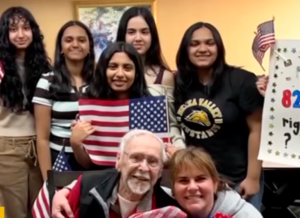
At one hundred years old, Ray Svejnoha never expected to relive a piece of youth that history had stolen from him more than eight decades earlier. Most people his age spend their days quietly reflecting on memories already made, but Ray still carried one small absence from his teenage years — a high school prom he never attended because World War II demanded something far greater from him than dancing, music, or teenage celebrations. Back when Ray was a student in Illinois, the world looked very different. Young men barely old enough to graduate suddenly found themselves facing military exams, enlistment papers, and the terrifying uncertainty of war. Ray had taken examinations for both the Navy and the Army Air Force, understanding that his future would soon belong not to himself but to his country. Like countless others from what later became known as the Greatest Generation, he accepted that duty came before personal milestones. While classmates planned tuxedos, dances, and photographs, Ray prepared for service. He left behind ordinary teenage experiences without complaint because millions of young Americans at the time believed sacrifice was simply what responsible people did. He served during one of the darkest periods in modern history, survived the war, and eventually returned home to build a long life filled with family, work, memories, and resilience. Yet even after decades passed, the story of the prom he missed remained tucked quietly within him. It was not bitterness that stayed with him but the simple understanding that an entire generation had surrendered parts of youth the world would never fully repay. For many people, prom is remembered as an awkward teenage dance, but for veterans like Ray, the missed event represented something larger — the childhood and innocence interrupted by global conflict. As the years passed, Ray likely assumed that chapter would remain permanently unfinished. Then a group of high school students heard his story and decided that eighty-two years was not too late to give someone the moment they had sacrificed for everyone else’s future.
The idea began at Metea Valley High School in Illinois, where students involved in the school’s Tech Connect club regularly spent time helping senior citizens with technology and everyday needs. Through conversations with residents at a local senior living community in Naperville, the students learned about Ray’s life and discovered the detail about the prom he never experienced. For many teenagers, the story felt almost impossible to imagine. Prom was something they naturally expected to attend, yet here was a man who gave up that ordinary rite of passage because his country needed soldiers during World War II. Instead of simply feeling sympathy, the students decided to act. Quietly and carefully, they began organizing a surprise unlike anything Ray expected. They prepared patriotic decorations, gathered balloons and American flags, and created a handmade sign that perfectly captured the emotion behind their gesture: “82 years late, but right on time.” When the students arrived to surprise Ray with the invitation, his reaction revealed both disbelief and gratitude. At one hundred years old, he was suddenly being asked to attend the high school prom he thought life had permanently denied him. The kindness deeply moved him because the invitation represented far more than a dance. It symbolized recognition. So often elderly veterans become invisible to younger generations, their sacrifices acknowledged mainly during holidays or ceremonies before daily life moves on again. But these students chose to stop, listen, and restore a small piece of joy to someone whose generation had once carried the world through war. Ray later admitted he was overwhelmed simply that they had thought about him at all. In a time when public conversations frequently focus on division between generations, the gesture became a powerful reminder that genuine compassion still exists. The students did not organize the evening for social media attention or praise. They did it because they believed a man who sacrificed his youth for his country deserved to finally experience the celebration he lost. Their decision transformed an ordinary school dance into something unforgettable for an entire community.
Once the surprise invitation became public, the surrounding community quickly rallied behind the effort. Local businesses, volunteers, and residents joined together to ensure Ray experienced every detail of the prom night he never had as a teenager. People who had never met him wanted to contribute something meaningful. Arrangements were made for a professional haircut and tuxedo fitting so he could prepare exactly like any graduating student would. Others helped organize transportation in a beautifully decorated vintage trolley filled with patriotic decorations and balloons. For one evening, Ray was no longer simply a resident at a senior community or a veteran remembered through old photographs. He became the honored guest of an entire town determined to celebrate him properly. As the evening approached, excitement spread throughout the school. Students prepared to welcome not only one of the oldest prom attendees imaginable but also a living connection to history itself. When Ray finally arrived at the dance, the response stunned him. Teenagers gathered cheering, applauding, and smiling as he entered the gymnasium. Cameras flashed, music played, and students eagerly invited him onto the dance floor. Yet despite the celebration, the atmosphere carried something deeper than novelty. Everyone understood that the moment represented gratitude toward a generation rapidly disappearing. The teenagers did not treat Ray like a museum exhibit or symbolic figure. They treated him like family. Watching students dance beside a veteran born more than a century earlier created a rare and beautiful image of generations meeting through kindness rather than conflict. Ray himself seemed deeply touched by the warmth surrounding him. At one point during the evening, he spoke emotionally about how much the experience meant, reminding everyone listening that not all stories about modern teenagers deserve criticism. Society often portrays younger generations as selfish or disconnected, yet these students demonstrated empathy many adults fail to show. Ray later reflected that while people constantly complain about teenagers, what those students did proved there is still goodness, compassion, and respect in the younger generation. His words carried enormous weight because they came from someone who had lived through war, social upheaval, and a century of human change. If anyone had earned the right to judge character, it was him.
As the night continued, the emotional significance of the event became impossible to ignore. Teachers, parents, veterans, and students all watched something extraordinary unfold — not because of flashy entertainment or expensive decorations, but because one act of thoughtfulness restored dignity to a forgotten sacrifice. Ray danced, smiled, laughed, and experienced the kind of ordinary teenage celebration most people take for granted. Yet unlike a typical prom, this evening carried eighty-two years of history behind every moment. Many students later admitted the experience changed the way they viewed both veterans and aging itself. Before meeting Ray, World War II may have felt distant to them, confined mostly to textbooks and documentaries. But standing beside someone who had actually left school to serve during that era transformed history into something real and human. Ray was no longer just a veteran from another generation. He was a teenager who once gave up a dance because his country needed him elsewhere. That realization created an emotional bridge between young people and history itself. Some students reportedly spent hours listening to his stories, asking questions about the war, his life afterward, and what it felt like to suddenly leave adolescence behind for military service. In return, Ray experienced something equally meaningful: proof that younger generations still care deeply about honoring sacrifice when given the opportunity. The prom became more than compensation for a missed milestone. It became a celebration of memory, gratitude, and connection between people separated by nearly a century of life experience. Watching teenagers enthusiastically welcome a 100-year-old veteran into their world offered a rare kind of hope in a culture often consumed by negativity. For one evening, nobody focused on political arguments, online outrage, or generational stereotypes. Instead, a gymnasium filled with music became a place where kindness mattered most. The emotional impact spread far beyond Illinois as videos and photographs circulated online, inspiring people across the country. Millions who saw the story reacted with admiration, many admitting the gesture brought them to tears because it reflected the kind of humanity people fear society is losing.
Perhaps the most beautiful part of the entire story was how naturally the students embraced Ray once he arrived. There was no sense of obligation or staged politeness. They genuinely wanted him there. Teenagers who had grown up in a completely different world from his treated him with affection and excitement rather than distance. Some danced beside him while others simply stood talking and listening with genuine curiosity. Teachers later described the atmosphere as emotional but joyful — not sad or nostalgic, but deeply life-affirming. Ray himself seemed to absorb every second carefully, understanding how extraordinary it was to receive such love from people young enough to be his great-grandchildren. At one point, he addressed the crowd directly, thanking everyone involved and telling them how much the evening meant to him personally. His gratitude was simple and sincere. After surviving war, living through enormous historical changes, and reaching the remarkable age of one hundred, he was still capable of being surprised by kindness. That fact alone moved many people online who followed the story afterward. In an age where cynicism often dominates headlines, the image of teenagers organizing a prom for a veteran who missed his own because of World War II reminded people that compassion does not disappear unless society stops teaching it. Ray’s story also forced many viewers to reflect on the hidden sacrifices older generations quietly carried throughout their lives. Millions of veterans lost ordinary milestones — dances, graduations, relationships, opportunities — because history demanded impossible choices from them. Most never complained. They simply moved forward, built families, worked hard, and carried those missing pieces privately. By giving Ray his long-overdue prom, the students acknowledged that those sacrifices mattered not just historically but personally. They recognized the human being behind the uniform. And perhaps that is why the story resonated so deeply with people everywhere. It was not only about honoring military service. It was about restoring something tender and personal to someone who had once sacrificed it for others.
Long after the music ended and the decorations came down, the story of Ray Svejnoha’s prom continued inspiring people because it represented something larger than a single evening. It reminded the world that acts of kindness do not lose value simply because time has passed. Eighty-two years after missing prom, Ray finally received the celebration he never expected to experience. But the event also gave something important back to the students and community who organized it. In honoring him, they rediscovered empathy, gratitude, and human connection in a world that too often rushes past those things. Ray left the dance knowing younger generations still remembered and respected people like him. Meanwhile, the students gained a memory they would likely carry for the rest of their lives — the night they danced beside a man who once sacrificed his youth so others could have theirs. The beauty of the story lies not only in the delayed prom itself but in the realization that compassion can bridge even the widest distances between generations. A teenager born in the 2000s and a veteran born in the 1920s found common ground through simple humanity. In the end, Ray’s long-overdue prom became more than a celebration. It became proof that gratitude never expires, sacrifice should never be forgotten, and sometimes the most meaningful moments in life arrive decades later than expected — but still exactly when they are needed most.