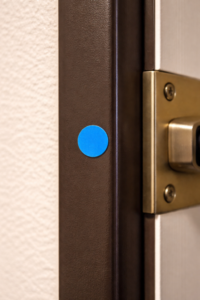
Many travelers pride themselves on being alert. They double-check door locks. They scan the room when they arrive. They notice small details others might overlook. That awareness is usually a good thing—especially when staying in an unfamiliar place. But sometimes, heightened alertness collides with misinformation, and something completely ordinary suddenly feels alarming.
Few things illustrate this better than the tiny blue dot sticker that some guests notice on hotel room doors.
t’s small.
It’s subtle.
And it’s usually placed where your eyes naturally fall—near the door frame, latch, or handle.
That combination is enough to make people uneasy. Add in a few viral posts, ominous captions, and vague warnings online, and suddenly a harmless sticker becomes the focus of anxiety, speculation, and fear.
So what does that blue dot really mean?
The answer is far less dramatic than the internet would have you believe—but understanding it fully requires looking at how hotels actually operate behind the scenes, how internal systems work, and why human brains are wired to fear unexplained symbols in unfamiliar environments.
Why Small Details Feel Bigger When You’re Traveling
Travel places people in a heightened state of awareness. You’re sleeping in a bed that isn’t yours, surrounded by unfamiliar sounds, layouts, and routines. Your brain is constantly scanning for cues: Is this place safe? Is this normal?
In that state, even minor irregularities stand out.
A loose screw.
A stain on the carpet.
A sticker you’ve never noticed before.
Because hotels are transitional spaces—places we don’t fully control—anything unexplained can feel threatening, even when it isn’t.
The blue dot sticker taps directly into that psychological vulnerability.
What the Blue Dot Sticker Usually Is
In the vast majority of cases, a blue dot sticker on a hotel room door is nothing more than an internal operational marker.
Hotels use color-coded systems constantly. These systems are not designed for guests. They are designed for staff efficiency, communication, and accountability.
A blue dot sticker may indicate:
The room has been cleaned
The room has been sanitized
The room has been inspected
The room is cleared for occupancy
The room is scheduled for minor maintenance
The room has passed a quality-control check
These stickers are often:
Temporary
Removed quickly
Forgotten once their internal purpose is fulfilled
They are meant to be recognized by housekeeping supervisors, maintenance staff, or managers—not interpreted by guests.
Why Hotels Use Stickers Instead of Digital Notes
Many travelers assume everything in hotels is tracked digitally. While that’s partly true, physical markers are still widely used because they are:
Fast
Visible
Fail-proof
Accessible to all staff, regardless of language or system access
Housekeeping teams often work under tight time constraints. A small colored sticker can instantly communicate information without requiring logins, devices, or paperwork.
For example:
A supervisor walking a hallway can tell at a glance which rooms are cleared
Maintenance staff can quickly identify rooms needing follow-up
Cleaning teams can avoid duplicating work
In other words, the sticker is a logistical shortcut, not a message.
Why the Sticker Is Often Near the Door
This placement fuels suspicion, but it’s also the most practical location.
The door frame or latch area is:
Highly visible to staff
Unlikely to be damaged during cleaning
Not obstructed by furniture
Easy to remove or replace
It’s placed where staff naturally look—not where guests are meant to analyze it.
Why Blue Is a Common Color
Blue is commonly used because:
It stands out against most door colors
It’s associated with cleanliness and inspection
It’s less alarming than red
It’s easily distinguishable under different lighting
Different hotels use different colors for different purposes. Blue is simply one of the most neutral and practical choices.
How Social Media Turned Stickers Into “Warnings”
The fear surrounding blue dot stickers didn’t start in hotels—it started online.
A few viral posts claimed:
Stickers are used to mark rooms for trafficking
Dots signal which guests are alone
Colors are codes for criminal activity
These claims spread rapidly because they:
Trigger fear
Use vague language
Offer no verifiable sources
Encourage “warning others”
But no credible investigations, law enforcement agencies, or hospitality organizations have found evidence supporting these theories.
Criminal activity does not rely on visible stickers that could be noticed, removed, or questioned. Real threats depend on secrecy—not obvious markings.
Why These Rumors Stick So Easily
Humans are pattern-seeking creatures. When we see a symbol without context, our brains fill in the blanks—often with worst-case scenarios.
Add:
Travel stress
Fatigue
Unfamiliar environments
A few alarming posts
And suddenly, a harmless sticker becomes a perceived signal.
Fear spreads faster than reassurance.
What a Blue Dot Sticker Is Not
It is not:
A tracking device
A surveillance marker
A human trafficking signal
A warning about you personally
A sign your room is unsafe
These interpretations are based on speculation, not evidence.
When You Should Pay Attention
While blue dot stickers themselves are harmless, your instincts still matter. You should take action if you notice:
A sticker that appears tampered with repeatedly
Signs of forced entry
A lock that doesn’t work
Someone attempting to enter your room
Staff behavior that feels inappropriate
In those cases, the sticker isn’t the issue—the behavior or condition is.
The Correct Response If You’re Concerned
If you see a sticker and feel uneasy:
Call or visit the front desk
Ask what the sticker means
Request removal if it bothers you
Ask for a room change if peace of mind matters
Hotels expect these questions. Staff are trained to answer them.
You are never wrong for asking.
Why Peace of Mind Matters More Than Being “Right”
Even if something is harmless, anxiety can ruin a stay. You don’t need proof of danger to advocate for your comfort.
Hotels want guests to feel safe—not stressed.
A simple conversation often resolves everything.
Why You’re Seeing These Stickers More Often Now
In recent years, hotels have increased:
Sanitation protocols
Inspection tracking
Quality-control checks
This means more temporary markers, not fewer.
The rise in visibility doesn’t mean increased risk—it means increased oversight.
The Bigger Lesson About Travel Safety
True travel safety isn’t about decoding symbols or fearing hidden messages. It’s about:
Awareness
Communication
Trusting verified information
Asking questions instead of assuming
Most danger doesn’t announce itself with stickers.
Most safety comes from clarity.
Final Reassurance
If you spot a tiny blue dot sticker on a hotel room door, you are almost certainly seeing:
A housekeeping or maintenance marker
A routine internal label
A harmless operational tool
It is not a warning.
It is not a code.
It is not about you.
Staying informed, calm, and grounded is the best protection you can carry with you.
And sometimes, the safest thing you can do is simply ask—and let fear stop at the front desk.